



Description
x• Indiqué pour les personnes souffrant d'anémie ferriprive et de symptômes associés de fatigue, de perte de cheveux, de troubles cognitifs, de mauvaise humeur, d'immunité affaiblie et de déséquilibre hormonal
Le fer continue d'être la carence en nutriments la plus manifeste dans le monde développé, avec une prévalence particulièrement élevée chez les femmes et pendant la grossesse. En fait, 1 femme sur 2 sera carencée en fer à un moment donné de sa vie et encore plus souffrira de symptômes associés à des niveaux de fer sous-optimaux. Bien que la fatigue, la faiblesse, la perte de cheveux et la pâleur soient des symptômes classiques de l'anémie ferriprive, de faibles niveaux de fer affectent de nombreux autres systèmes de l'organisme.
Par exemple, la carence en fer s'est avérée être une cause fréquente du syndrome des jambes sans repos dans environ 1 cas sur 4 et une supplémentation en fer peut améliorer les symptômes. On pense que cela est réalisé par la régulation à la hausse par le fer de la synthèse de dopamine à partir de la tyrosine. Il est également bien documenté que les enfants et les adultes obtiennent de moins bons résultats aux tests de la fonction mentale dans les états de carence en fer, des domaines tels que l'attention, la mémoire et la concentration étant affectés.
Le fer joue également un rôle essentiel dans de nombreuses voies hormonales. Le fer est nécessaire pour la conversion thyroïdienne de la thyroxine (T4) en triiodothyronine (T3) et, en cas d'hypothyroïdie avec carence concomitante en fer, le traitement combiné avec du fer et de la lévothyroxine s'est avéré supérieur à chaque traitement seul. Chez les femmes ayant des saignements menstruels abondants, une carence en fer peut en fait provoquer un état récurrent de saignements menstruels abondants par l'affaiblissement des muscles utérins, aggravant ainsi la condition. Les preuves montrent également que les femmes souffrant d'infertilité inexpliquée et d'un statut en fer sous-optimal peuvent bénéficier d'une thérapie de restauration du fer.
Enfin, le fer est nécessaire au bon fonctionnement immunitaire grâce à la production de cytokines dans les macrophages et un état de carence en fer peut entraîner une réponse immunitaire insuffisante. Par exemple, des recherches sur des personnes atteintes de candidose buccale ont montré que la restauration du fer peut réduire le nombre de candidoses salivaires et réduire les lésions buccales.
Malgré tous les avantages pour la santé d'une supplémentation ciblée en fer, de nombreuses femmes et personnes carencées en fer hésitent à prendre des suppléments de fer ou deviennent non conformes en raison d'effets secondaires digestifs tels que la constipation, les nausées et les maux d'estomac.
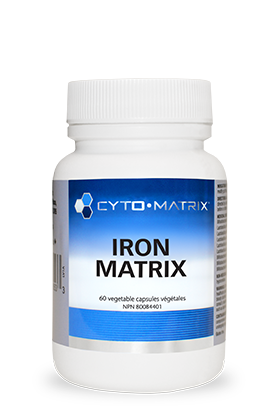
La matrice de fer de Cyto-Matrix contient du fer sous forme chélatée, bis.glycinate, optimale pour une absorption et une action douce sur le tube digestif. Cela réduit considérablement la probabilité de complications indésirables lors de la supplémentation en fer. Chaque gélule contient 20 mg de fer élémentaire avec des vitamines C, B6, B12, de l'acide folique, du magnésium et du cuivre supplémentaires pour aider à l'absorption du fer du tube digestif et aider à la production de globules rouges sains.
Indicated for people suffering from iron deficiency anemia and associated symptoms of fatigue, hair loss, cognitive impairment, low mood, weakened immunity, and hormonal imbalance.Iron continues to be the most prominent nutrient deficiency in the developed world, with a particularly high prevalence among women and during pregnancy. In fact, 1 in 2 women will be iron deficient at some point in their lives, and even more will suffer from symptoms associated with suboptimal iron levels. While fatigue, weakness, hair loss, and pallor are classic symptoms of iron deficiency anemia, low iron levels affect many other body systems. For example, iron deficiency has been shown to be a common cause of restless legs syndrome in approximately 1 in 4 cases, and iron supplementation can improve symptoms. This is thought to be achieved by iron's upregulation of dopamine synthesis from tyrosine. It is also well documented that children and adults perform worse on tests of mental function in iron-deficient states, with areas such as attention, memory, and concentration being affected. Iron also plays a critical role in many hormonal pathways. Iron is required for the thyroid's conversion of thyroxine (T4) to triiodothyronine (T3), and in hypothyroidism with concomitant iron deficiency, combined treatment with iron and levothyroxine has been shown to be superior to either treatment alone. In women with heavy menstrual bleeding, iron deficiency may actually cause a recurring state of heavy menstrual bleeding by weakening the uterine muscles, thereby worsening the condition. Evidence also shows that women with unexplained infertility and suboptimal iron status may benefit from iron restoration therapy.Finally, iron is necessary for proper immune function through the production of cytokines in macrophages, and an iron-deficient state can result in an insufficient immune response. For example, research on people with oral thrush has shown that iron restoration can reduce the number of salivary thrush infections and reduce oral lesions.Despite all the health benefits of targeted iron supplementation, many women and individuals with iron deficiency are reluctant to take iron supplements or become noncompliant due to digestive side effects such as constipation, nausea, and stomach upset.Cyto-Matrix's iron matrix contains iron in a chelated, bisglycinate form, which is optimal for absorption and gentle action on the digestive tract. This significantly reduces the likelihood of unwanted complications during iron supplementation. Each capsule contains 20 mg of elemental iron with additional vitamins C, B6, B12, folic acid, magnesium, and copper to aid in the absorption of iron from the digestive tract and support the production of healthy red blood cells.
Adultes : Prendre 1 à 2 gélules par jour avec de la nourriture ou selon les recommandations d'un professionnel de la santé. Prendre quelques heures avant ou après la prise d'autres médicaments.
Adults: Take 1 to 2 capsules daily with food or as directed by a healthcare professional. Take a few hours before or after taking other medications.
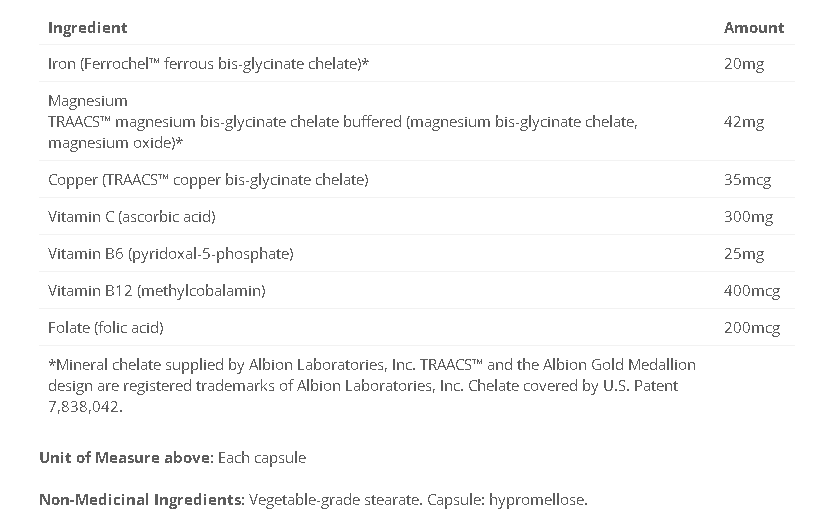
Ingrédient (par capsule):Fer (Ferrochel chélate de bis-glycinate ferreux) 20mgMagnésium TRAACS magnesium bis-glycinate chelate buffered (magnesium bis-glycinate chelate, magnesium oxide) 42mgCuivre (chélate de bis-glycinate de cuivre TRAACS™) 35mcgVitamine C (acide ascorbique) 300 mgVitamine B6 (pyridoxal-5-phosphate) 25 mgVitamine B12 (méthylcobalamine) 400mcgFolate (L-5-méthyltétrahydrofolate) 400mcg
Ingrédients non médicinaux : Stéarate de qualité végétale. Gélule : hypromellose.
Ingredients (per capsule): Iron (Ferrochel ferrous bis-glycinate chelate) 20 mg Magnesium TRAACS magnesium bis-glycinate chelate buffered (magnesium bis-glycinate chelate, magnesium oxide) 42 mg Copper (TRAACS™ copper bis-glycinate chelate) 35 mcg Vitamin C (ascorbic acid) 300 mg Vitamin B6 (pyridoxal-5-phosphate) 25 mg Vitamin B12 (methylcobalamin) 400 mcg Folate (L-5-methyltetrahydrofolate) 400 mcg
Non-medicinal ingredients: Vegetable-grade stearate. Capsule: hypromellose.
Produits recommandés
Example product title
- $25.99
- $25.99
- Unit price
- per
Example product title
- $25.99
- $25.99
- Unit price
- per
Example product title
- $25.99
- $25.99
- Unit price
- per
Example product title
- $25.99
- $25.99
- Unit price
- per
Example product title
- $25.99
- $25.99
- Unit price
- per
Example product title
- $25.99
- $25.99
- Unit price
- per
Example product title
- $25.99
- $25.99
- Unit price
- per
Example product title
- $25.99
- $25.99
- Unit price
- per
Example product title
- $25.99
- $25.99
- Unit price
- per
Example product title
- $25.99
- $25.99
- Unit price
- per
Produits récemment consultés
Example product title
- $25.99
- $25.99
- Unit price
- per
Example product title
- $25.99
- $25.99
- Unit price
- per
Example product title
- $25.99
- $25.99
- Unit price
- per
Example product title
- $25.99
- $25.99
- Unit price
- per
Example product title
- $25.99
- $25.99
- Unit price
- per
Example product title
- $25.99
- $25.99
- Unit price
- per
Example product title
- $25.99
- $25.99
- Unit price
- per
Example product title
- $25.99
- $25.99
- Unit price
- per
Example product title
- $25.99
- $25.99
- Unit price
- per
Example product title
- $25.99
- $25.99
- Unit price
- per
- Choosing a selection results in a full page refresh.